
Find a Builder Who Won't Go Bust: Start Before You Sign
Don't rely on a single rushed quote and a prayer. This blog reveals how to get multiple quotes so you can execute an exact strategy on how to compare builder quotes, quickly spot the red flags that show a builder is going bust, and confidently check if a builder is financially stable to protect your build.
4 min read
Many people ask the same question: "How do I pick a builder who won't collapse halfway through?" It is a vital question, but most people skip the exact step that answers it:
Obtaining detailed, comparable quotes.
But doing this is harder than it sounds. Here’s why, and how a specific approach fixes it.
The Catch-22 That Traps Every Homeowner
Good builders are busy. Accurately pricing a custom home takes three to four days of intense admin work—measuring every item, calculating labor, and sourcing current supplier prices. That’s 4 days of work.
Even if you are lucky enough to find one good builder willing to put in that effort, you have no way of knowing if their price is fair without a point of comparison.
You need two or three other quotes to compare.
This is the paradox of the Australian building industry. It is why most homeowners spend months waiting, just to end up with a single, rushed quote, a handshake, and a prayer.
The One Document That Changes Everything
There is a document most homeowners have never heard of: a Bill of Quantities (BoQ).
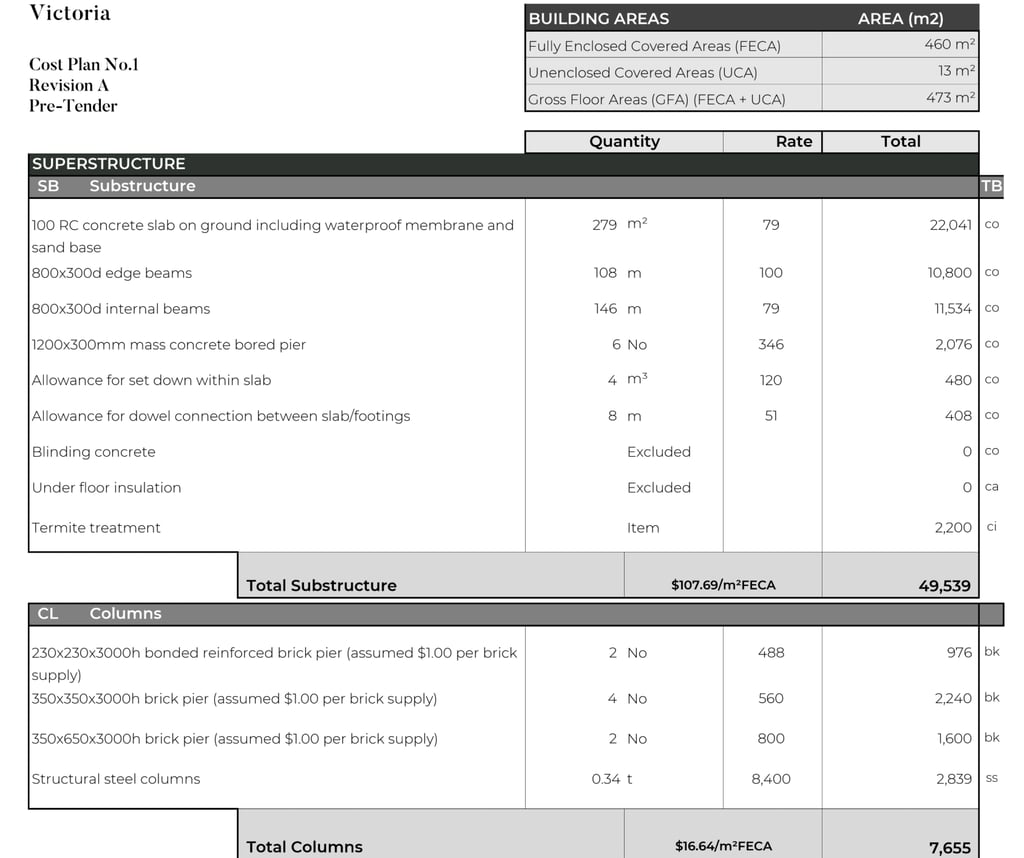
A BoQ is essentially a comprehensive construction Cost Plan with the dollar figures removed. It lists every single item required for your build—the exact amount of brick, conduit, plasterboard, concrete, tile, timber, and the specific labor hours involved.
A professional Quantity Surveyor (QS) prepares this document directly from your architectural and engineering drawings.
Normally, your QS provides a complete "Cost Plan," which includes [Item] | [Quantity] | [Fair Market Rate] multiplied to estimate your total construction cost.
If you remove the fair market rates, you are left with the unpriced BoQ.


Why it matters?
Measuring and calculating the BoQ is what takes a builder three days. If you supply a ready-made BoQ to a builder, their quoting time drops from ‘days’ to ‘hours’.
How to compare builder quotes?
Instead of begging one or two builders to quote your project, you can approach ten or fifteen. If you receive five quotes, then select and interview two finalists based on price, your chances of securing a reliable, solvent builder at a reasonable price improve significantly.


The Hidden Value: Initial Pricing & Variations
1. Cross-Checking Categories
Builders rarely disclose individual trade rates because they treat their specific margins and subcontractor pricing as confidential.
However, the builder should still provide a breakdown of the main cost categories.
You can then cross-reference these categories against your Quantity Surveyor’s Cost Plan. If a category is significantly higher or lower, you can flag it to ensure no trade has underquoted—which causes problems later—and no one is overcharging.
2. Negotiating Variations
Having access to category totals gives you a baseline for the future. If the builder claims a variation down the line, you have documented figures to work from. This prevents builders or subcontractors from pulling inflated numbers out of a hat and charging thousands of dollars for simple work.
Warning Signs Before You Sign the Contract:
To protect your investment, you need to recognize the signs a builder is going bust in Australia before handing over any money.
1. Too good to be true, it usually is
A price well below market standard means corners will be cut, or heavy variations will land later.
2. Prime Cost (PC) or Provisional Sum (PS) items
A few are normal for unselected finishes, but too many means you are taking on a lot of risk. Ask the builder to confirm the materials and convert the PC/PS items into fixed lump sums..
3. Unusually large deposits
Depending on your state's legislation, a 5% to 10% deposit is standard for residential construction. Requesting more than the legal limit without a valid, clear reason is a major red flag.
How to check if a builder is financially stable?
If you want to know how to check if a builder is financially stable, the most reliable first step is to run a company history check with ASIC.
https://connectonline.asic.gov.au/RegistrySearch/faces/landing/bn/SearchBnRegisters.jspx
A building company that has traded under the exact same name and ACN for over five years, with a proven track record of completed projects similar to yours, is statistically much safer.
It does not offer a 100% guarantee, but it screens out fly-by-night operators.
After Signing the Contract:
Once the contract is ready, line up these four documents and verify that the names match exactly:
Your formal quote
The domestic building contract
The builder’s registered practitioner license
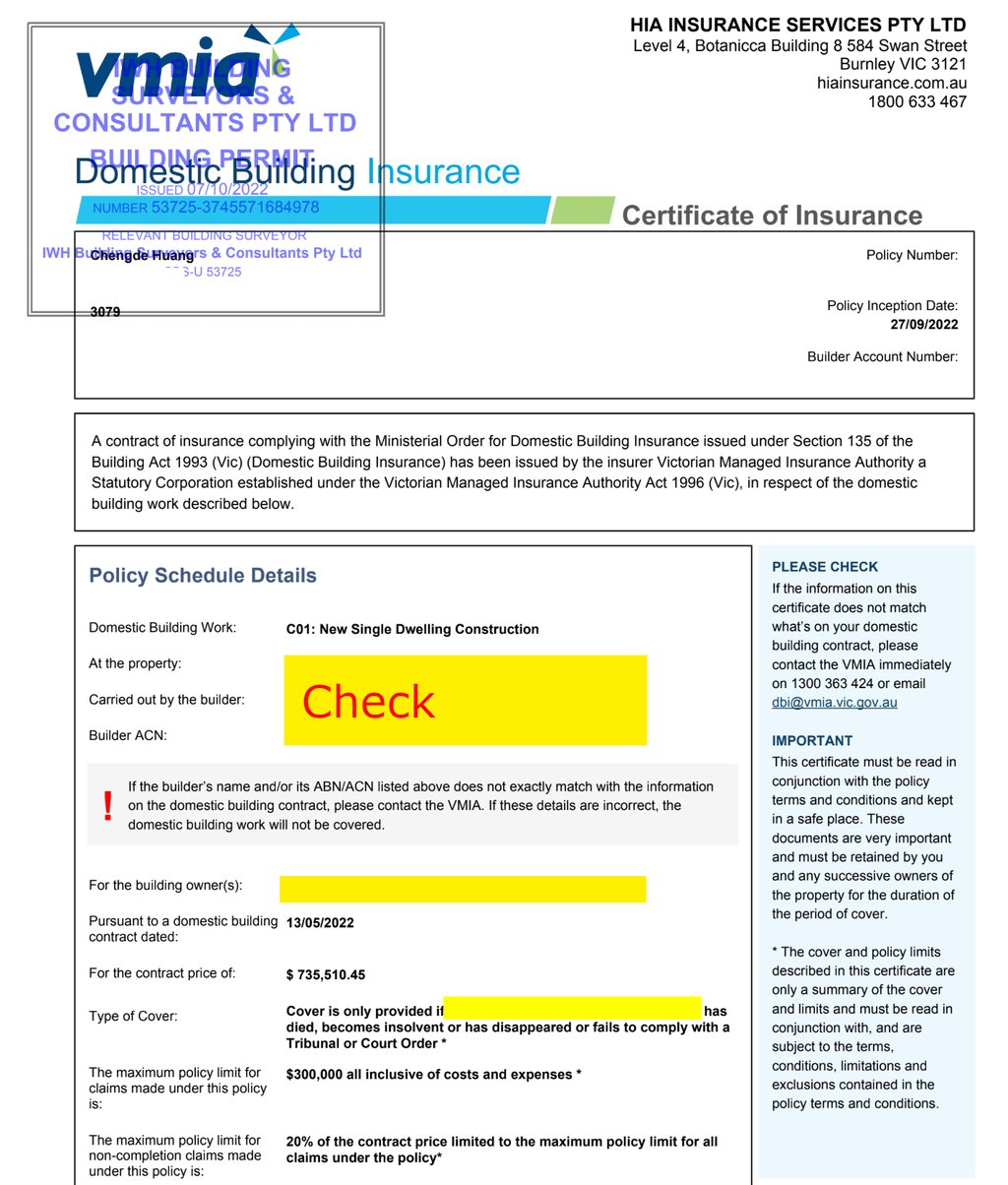
Your Domestic Building Insurance (DBI) certificate (or state equivalent)
Every entity name, ABN, and registration number must be identical across all four. If they do not align perfectly, stop. A mismatch can void your insurance.
Due to documented cases of forged insurance certificates in the industry, do not rely solely on others. While building surveyors require a copy of the certificate to issue a building permit, authenticating it is not always part of their standard operating procedure.
Take control and verify the certificate yourself using official portals https://www.buildvic.vic.gov.au/ClaimsPortal/s/verify-noc
When Things Go Wrong Anyway
Even the most rigorous vetting cannot prevent every issue.
Residential construction involves more than thirty distinct trades. One unreliable subcontractor can create a domino effect of delays.
When hitches occur, focus entirely on resolving the problem rather than assigning blame. Maintain a realistic contingency fund; absorbing a small, justified cost early in the build often prevents catastrophic delays later.
FAQ: What if the BoQ Contains Errors?
Your BoQ is prepared by a professional Quantity Surveyor who possesses the same level of construction expertise as a builder. While minor errors can occur, the differences are usually negligible.
Even if a major item is omitted, every builder at the quotation stage is still pricing the exact same scope. You get identical items, identical quantities, and identical quality.
For the first time, you can truly master how to compare builder quotes apples-to-apples, removing the guesswork of whether Builder A included the driveway while Builder B left it out.